Feeling like a fraud? You're in good company


Hi there,
Have you ever sat in a meeting and thought, 'Any minute now, someone is going to realise I shouldn't be here'? If so, you're in very good company.
This month, my focus has been imposter phenomenon, which I've explored across a short series of podcast episodes and on the blog. It's definitely an evergreen topic in coaching and people development at work. But it's also quite misunderstood and the root cause of some real challenges for job satisfaction, wellbeing and career progress.
I also have a birthday to celebrate, and an important date for your diary! Read on to find out more.
Feeling like an imposter, and what to do about it
Imposter phenomenon (often mistakenly referred to as 'imposter syndrome') is the experience of feeling that your success and your position are down to luck rather than talent, and that at any moment it could all come crashing down. I prefer 'phenomenon' because it's a common human experience, not a medical condition.
The term dates back to 1978, when psychologists Pauline Clance and Suzanne Imes first described it among high-achieving women. It has since been found in men too, and it's common across professions.
It's important not to put all the focus on the individual experiencing this, though. Organisational and cultural factors can contribute to the experience. These include a lack of quality feedback and messaging that sounds like 'You're only as good as your last project here...'
Healthy self-doubt or something more?
A bit of self-doubt is perfectly healthy. Before a big presentation, it nudges us to prepare and to seek feedback. When we encounter new experiences or contexts, those feelings inside just highlight the novelty and lack of experience to draw upon.
What marks out imposter phenomenon is how persistent it is, and how readily it explains away the evidence. You can have the qualifications, the track record and the positive feedback, and still put it all down to luck or good timing.
Why it matters at work
That combination of uncertainty and worry can lead to some unhealthy ways of working, while also eroding job satisfaction and relationships.
When you believe it can all come crashing down at any moment, you're more likely to work harder and longer, in some quite unsustainable ways. It can also prevent you from stepping up to new opportunities or challenges, as your focus is on avoiding any scrutiny of your skills and ability. So we frequently see very able employees not reaching their full organisational potential - all because of their internal imposter voice.
It shows up in coaching too. Imposter feelings can lead people to mask how they really feel, to seek approval, and to see their coach as an authority figure to impress. The result can be a polished performance without much depth or openness, followed by uncomfortable rumination about what was said.
And of course, coaches aren't immune: in the final episode of the series outlined below, I turned the lens on myself and my peers.
What to do about it
If the description above reminds you of your own experience, take some time to try the suggestions below and notice the difference it makes.
- Establish what good looks like. The absence of any specificity when it comes to standards means the only thing you have to fall back on is 'better'. Ask your stakeholders for guidance on what's expected of you, how long to spend on tasks and any wider context that will help you gauge the effort and time required.
- Set your finish line. I often refer to the imposter experience as like running a race when you can't see the finish line or the other competitors. Use goals - and interim, smaller goals - to get specific when it comes to deadlines, scope, and the journey towards completion.
- Get some distance from the thought. The next time a thought like 'I don't belong in this role' turns up, try adding a prefix: 'I'm having the thought that I don't belong in this role.' It's a small shift, but it helps you see a thought as a thought rather than a fact. That's what we call cognitive defusion.
- Say it out loud. Mention it to a colleague, mentor or coach you trust. It's a small act of connection, and you may well discover you're not the only one. Suddenly, the experience is far less lonely.
- Lean into self-compassion. Ask yourself how you'd respond if a loved one confided that they have the same kinds of doubts about their competence and career progress. Now bring some of that kindness to your own self-talk and notice how less harsh it sounds.
Find out more
I've gathered all our resources on this topic onto one place on the website at worklifepsych.com/imposter. Whatever your preference, we have resources you can access and enjoy on the go.
🎧 Podcasts
- Ep 227: An owner's manual for the mind. How we relate to our own thoughts, and the concept of cognitive defusion.
- Ep 228: Help! I feel like an imposter!. Dr Hayley Lewis and I discuss what imposter phenomenon is, how it differs from healthy self-doubt, and what to do about it.
- Ep 229: There are no prizes in coaching. How imposter feelings can show up in coaching, and what coachees can do about it.
- Ep 231: What if your coach feels like an imposter too? What happens when the coach is the one doubting themselves, and what I do about it as a coaching psychologist.
✏️ Blog posts
Prefer reading? Start with Feeling like a fraud or Ten ways to beat your imposter phenomenon. I've also explored the coaching experience in Trying to Win and When your coach feels like an imposter.
🎬 Video
Finally, you can watch my take on the experience - and what you can do about it - in this video.
🥳 Nine years of My Pocket Psych
Nine years ago, I pressed record on the very first episode of My Pocket Psych, nerves and misgivings and all. I'm pleased to say the show has developed enormously since then, and it's now something I genuinely enjoy making, especially when I know it's useful.
To mark the occasion, Ep 230 is a short one, and includes some lovely feedback from a listener all the way over in Maui, Hawaii. Have a listen (it's only 12 minutes long).
📆 'After Hours... with Dr Hayley Lewis'
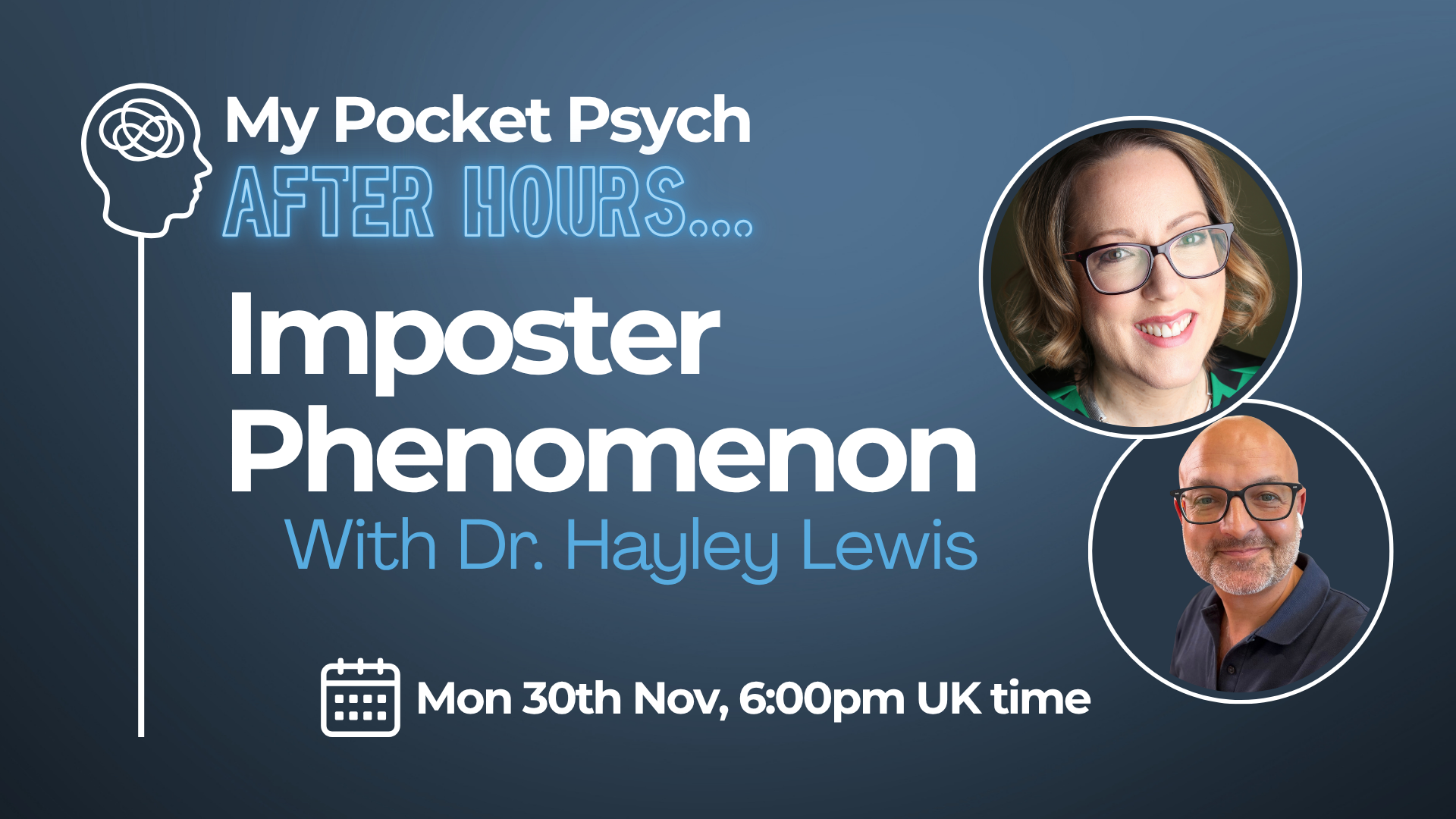
My guest on Ep 228, Dr Hayley Lewis, is returning for our next quarterly 'After Hours' session on Monday 30 November at 6pm UK time. She'll be answering your questions about imposter phenomenon.
The session is exclusive to members of WorkLifeSpark, our online personal development community. Membership is free, you can submit your questions in advance, and the recording will only be available to community members. Sign up here.
📚 And if you work in consultancy, take a look at Hayley's new book, co-written with Dr Clare Mulligan-Foster: 'Applying Psychology to Consulting': From theory to practice. Pre-orders opened on 27 October, and you'll get 20% off on the Routledge website with the code 26SMA3.
Before you go...
🤔 If imposter feelings, or the pressure to look as though you have it all figured out, are getting in the way for you or your team, you can book a free chemistry session to see whether one-to-one coaching would help, or read what to expect from coaching first.
And do get in touch if you'd like to explore how these themes could be built into your wellbeing or leadership programmes.
As ever, thank you for reading.
All the best,
Richard